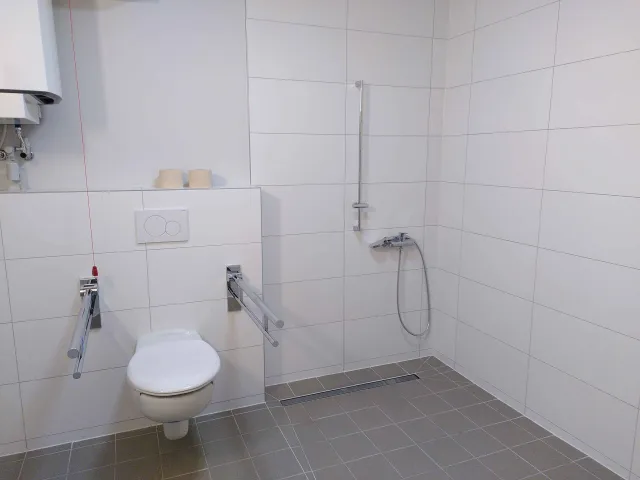
Programme nearbyCommunityFrankfurtExperience inclusive performing arts at Frankfurt LABExperience inclusive performing arts at Frankfurt LAB Frankfurt LAB at Schmidtstraße 12 is a music, theatre, and dance lab for contemporary work. Its Barrierefreiheit page documents rollstuhlgängige halls, companion service on request, welcome for assistance dogs, and a growing share of performances with audio description or German Sign Language. What you can do - Check accessibility notes before you book or drop into a free session - Ask the box office (069-739 416 93) for a suitable seat or companion support - Attend festival workshops such as Towards Reshaping Dance Education that share inclusive training methods - Suggest improvements: the venue invites feedback from people who encounter barriers How it works Public halls and the foyer are step-free. Some artist dressing rooms remain partially accessible; staff help find workarounds. Room measurements are published on frankfurt-inklusiv.de. Why it matters Culture belongs in the room only when everyone who lives nearby can actually get in.accessibilityinclusiontheatre +2
Programme nearbyCommunityBrasiliaBridge peripheries through Diálogos com TerritóriosBridge peripheries through Diálogos com Territórios Diálogos com Territórios is SESI Lab's inclusion programme, linking the museum with cultural groups and social organisations from Brasília's peripheries. Residencies combine maker skills, audiovisual work, entrepreneurship, accessibility, and environmental education so communities co-create the science culture instead of only receiving it. What you can do - Watch SESI Lab programming and news for open showcases, oficinas, and calls tied to Diálogos - Follow O SESI Lab educational programmes if your collective works with youth, culture, accessibility, or environmental education - Attend the free public showcases when residencies close (past cycles have produced games, prototypes, publications, and performances) - Connect partner organisations (coverage cites groups such as Jovem de Expressão and Casa Akotirene) through the museum's education team How it works Selected DF groups join mentored residencies with dozens of formation hours, then share results with the public. Cycles are periodic, so treat each closing date as a window into an ongoing programme rather than a single ticketed festival. Why it matters Climate and energy decisions land hardest on the edges of a city. A museum that runs its environmental education with those neighbourhoods, not about them, is how science culture stops being a downtown privilege.inclusionresidencyculture +2
Programme nearbyRepair & ReuseLondonStart women and gender-variant bike repair eveningsLearn wrench skills in a welcoming workshop The London Bike Kitchen runs a Hackney workshop where riders fix their own bikes with mechanic support. Women and gender-variant (WaG) nights create space for people underrepresented in cycle repair to ask questions without pressure. What you can do - Visit lbk.org.uk for workshop hours and WaG night dates - Book a maintenance class or drop-in session with your bike - Replicate the WaG model: reserve one evening a month for women and gender-diverse learners How it works LBK provides stands, tools, and coaches. WaG nights rotate on a regular schedule so members can build skills progressively. The worker co-op trains female and non-binary mechanics as teachers. Why it matters Bike repair opens streets and saves money. Dedicated evenings lower the barrier for people told tools are not for them.repaircyclingwomen +2
Programme nearbyCommunityBlagoevgradBlagoevgrad: pictorial waste separation guide for all residentsA guide designed so everyone can understand it In Blagoevgrad, Za Zemiata and the municipality developed a pictorial household waste separation guide as part of the #ForkToFarm campaign: designed to be accessible to residents regardless of literacy level, language background, or prior environmental knowledge. The guide uses clear illustrations to show what goes where, reducing the confusion that causes contamination of sorted streams. What the guide covers - Visual instructions for each waste category: kitchen organics, recyclables, mixed residual - Pictorial representation of common items that are frequently sorted incorrectly - Distributed in print through municipal services, schools, and community centres - Designed with input from local government to reflect Blagoevgrad's specific waste collection infrastructure How to engage - Blagoevgrad residents: pick up the guide from your municipal waste service or community centre and use it to review your household sorting habits - Other Bulgarian municipalities: contact Za Zemiata to adapt the Blagoevgrad pictorial guide for your own local waste system - Educators: use the guide in school waste workshops: the visual format works especially well with younger children and parents who have limited experience with sorting systems Why it matters Clear communication is the lowest-cost, highest-impact intervention in source separation. When residents know what to do, sorted waste quality improves, recyclers accept more material, and the financial case for collection strengthens.educationwaste-sortinginclusion +2
Programme nearbyCommunityAmsterdamOpen an inclusive makerspace and learning labTeach fabrication skills in a room where beginners belong Fab City links local hubs where residents learn CNC, textiles, electronics, and repair side by side. The Learning Hub shares toolkits so any neighbourhood can start an open workshop with equity at the centre. What you can do - Explore Fab City as a Learning Ecosystem and the Hubs Toolkit for your city - Browse open resources on fab.city/learning-hub for curricula and governance patterns - Join the Fab City network when your group is ready to commit to local production How it works A hub maps tools, trainers, and partner schools. Open days invite residents who rarely access STEM spaces. Projects document designs so knowledge travels across the network. Why it matters Makerspaces turn consumers into builders. Inclusive labs widen who gets to shape the objects and systems they live with.makerspaceskillseducation +2
Programme nearbyRepair & ReuseFrankfurtRun a skills-inclusive open repair workshop in FrankfurtRun a skills-inclusive open repair workshop in Frankfurt The Repair Café Frankfurt-Sachsenhausen offers free help fixing toasters, bikes, and jumpers in a café atmosphere. Volunteers explain each step so visitors leave with working goods and new confidence. What you can do - Check the Frankfurt Repair Café calendar for the next open session - Bring one broken household item and ask to watch the repair - Volunteer as a learner-greeter if you want to help newcomers feel welcome How it works Skilled fixers pair with visitors at shared tables. No appointment needed: drop in, queue briefly, and learn by doing. The network shares dates for Repair Cafés across Frankfurt. Why it matters Repair skills cut waste and repair bills. Cafés that expect questions build a culture where everyone can pick up a screwdriver.repairskillsworkshop +2
Programme nearbyCommunityLeipzigSupport Fairmined Credits for Corazones de OroFund inclusion in Pacarní with one gram of impact Fairever offers Fairmined Credits: each credit stands for one gram of responsibly mined gold from Iquira, Colombia. The physical gold stays in the local market; the credit pays extra impact. Most of the price supports Corazones de Oro, an inclusion project for children and youth with special needs in Pacarní, with a share for the Alliance for Responsible Mining. What you can do - Buy a Fairmined Credit on the Fairever site (Corazones de Oro section) - Share the project with a makers’ group or repair café that wants a solidarity action without shipping gold - Follow Alliance for Responsible Mining for more ASM community programmes How it works Credits separate metal trade from social impact funding. Miners sell gold locally; buyers fund verified community work and ARM’s standards work. Why it matters Solidarity can travel farther than a parcel — one credit ties European makers to a named Colombian community project.fairminedcreditssolidarity +2