Programme nearbyFood & GardenCologneGet a Biotonne: close the compost loop in CologneGet a Biotonne: close the compost loop in Cologne About 40% of what lands in the grey residual bin is compostable organic waste. In Niehl it is burned: costing money, CO₂, and fertile matter that could return to parks and gardens as torffreier Kölner Kompost. What you can do - Ask your landlord for the free brown Biotonne (tenants can use Zero Waste Köln’s postcard template on their project page). - Line the bin with newspaper, keep it in the shade, and skip “compostable” plastic bags: they need industrial conditions Cologne’s plants do not offer. - Buy Kölner Kompost or Blumenerde from AWB/AVG outlets (the Verein advocates more neighbourhood pick-up points). Why it matters Separate bio collection has been mandatory in Germany since 2015, but Cologne households still need to request the bin. Less bio in residual waste can mean a smaller (cheaper) grey bin.compostcircularlocal
Programme nearbyFood & GardenMunichBring Münchner Erden home from bio-waste in MunichBring Münchner Erden home from bio-waste in Munich Münchner Erden turn the city's separated bio-waste into torffreie potting mixes and quality compost at the Erdenwerk Freimann in Munich. The base compost comes from AWM's dry-fermentation plant next door: regional input, regional output. What you can do - Buy sack or bulk compost at the Erdenwerk Freimann (Werner-Heisenberg-Allee 62) - Pick up Münchner Bio-Erde or Qualitätskompost at participating Wertstoffhöfe and Halle 2 in Pasing - Start or improve a home composter using AWM garden tips alongside bought soil for gaps - Order larger loose volumes or delivery through the AWM Erden service when you are renovating beds How it works AWM mixes certified compost with selected substrates on site. Products are RAL-quality oriented and marketed for gardens, balconies, and lawn repair: proof that Munich's brown bin stream returns as living soil. Why it matters Peat-free city compost keeps moors intact and closes the loop between your Biotonne and the tomatoes on your balcony.compostcircularpeat-free +1
Programme nearbyRepair & ReuseLjubljanaBled STICT: circular textile challenge with international expertsTackling tourism's textile footprint Under the EU STICT (Sustainable Textiles In Circular Tourism) project, EBM partnered with the municipality of Bled and international sustainability experts to explore solutions for the environmental and economic impacts of textiles in a tourism-heavy destination. The initiative investigates sustainable sourcing, collection, and reuse of textiles across hotels, venues, and local businesses in the Bled area. What the project explores - Environmental footprint of hotel linen and event textiles - Collection and redistribution systems for reusable or recyclable textiles - Policy levers municipalities can use to shift procurement How to engage - Follow EBM for workshops and findings as the STICT project publishes results - If you manage a venue near Bled, ask EBM about participation in the textile audit pilot Why it matters Tourism destinations generate disproportionate textile waste. Bled's participation in STICT means findings apply directly to one of Slovenia's most visited areas: making lessons replicable for every European resort town.textilescirculartourism +1
Programme nearbyCommunityFlorenceCapannori: one of Europe's first certified Zero Waste citiesThe pioneer that showed it could be done Capannori, a municipality of about 45,000 people near Lucca in Tuscany, is one of Europe's first cities to achieve Zero Waste certification. It set out decades ago to prove that a community could dramatically reduce the waste it sends to landfill and incineration: not through technology fixes, but through source separation, reuse, and community involvement. What Capannori built - Door-to-door separate collection as the default for every household - A Zero Waste Research Centre (Centro Capannori Rifiuti Zero) studying product design flaws and advocating for producer responsibility - Composting and textile collection integrated alongside paper, glass, metal, and plastics - Waste reduction targets embedded in municipal planning Why it matters Capannori's model is not a product of wealth or special geography. It is a replicable template: start with ambitious separate collection targets, involve residents early, and redirect waste budget away from disposal toward prevention. The ZWE-certified result inspired dozens of Italian municipalities to follow. How to engage - Visit or contact Zero Waste Italy to learn how Capannori's model can be adapted for your municipality - Follow Capannori's zero waste research centre for publications and advocacy toolscertifiedcircularpioneer +2
Programme nearbyCommunityZagrebKrk Island: Europe's first certified Zero Waste island clusterSeven municipalities: one shared model Krk Island became Europe's first certified Zero Waste island when all seven of its municipalities: Krk, Baška, Dobrinj, Malinska-Dubašnica, Omišalj, Punat, and Vrbnik: achieved Zero Waste certification together through the waste company PONIKVE. The result: 60 % average separate collection and only 73 kg of residual waste per resident per year, compared to the Croatian national average of 247 kg. What makes Krk replicable - Door-to-door sorting integrated with the existing island waste system - Joint certification across multiple small municipalities sharing one operator - Farmers and hotels participate in the same collection circuits as households - Ongoing focus on waste prevention and reuse: not just better sorting How to get involved - If your municipality partners with PONIKVE, ask about volunteering in collection or composting - Visit or follow Zelena Akcija to support national Zero Waste certification advocacy Why it matters Krk shows that tourist islands: where seasonal waste peaks are hardest to manage: can still hit Zero Waste targets. The model is already inspiring other coastal communities across Croatia and beyond.islandcertifiedrecycling +2
Programme nearbyRepair & ReuseBrusselsSTICT: replicating textile waste prevention in BrusselsA city learning from the best textile programmes in Europe Brussels is participating in the STICT project (Sustainable Textile Innovation and Circular Transition), which compiles best-practice models for textile waste prevention and management and works with cities to implement and replicate them. Zero Waste Belgium leads the Brussels partnership, bringing evidence-based strategies to local authorities and businesses. What the project does - Documents the most effective textile collection, repair, and resale models from across Europe - Works with Brussels authorities to implement scalable textile waste prevention measures - Provides a replication toolkit so other cities can adopt proven approaches without starting from scratch - Connects local repair workshops, clothing swaps, and upcycling organisations into the city's circular textile network How to engage - Brussels residents: find local textile repair workshops and clothing swap events through Zero Waste Belgium - Textile businesses and retailers in Brussels: contact Zero Waste Belgium about participating in the STICT circular model - Other municipalities: request the STICT replication toolkit to adapt the Brussels approach to your context Why it matters Textiles are among the fastest-growing waste streams in Europe. Brussels joining STICT means a dense, fashion-forward city is building infrastructure for repair and reuse: sending a signal to the industry and giving residents real alternatives to disposal.textilesreuseprevention +2
Programme nearbyCommunityWarsawBaltic Sea coastal waste standards: building a replication model from UstkaTurning a Baltic port town's waste practices into a national template The Polish Zero Waste Association works with the gmina (municipality) of Ustka on the Baltic Sea coast, focusing on waste management standards suited to coastal environments: fishing debris, tourist-season surges, and marine plastic. The project aims to develop replicable standards for Baltic Sea coastal municipalities that other towns along the coast can adopt without having to start from scratch. What the project involves - Developing waste management standards specifically suited to coastal contexts - Collaboration with Ustka on ghost net management (see linked initiative below) - Knowledge sharing with the Pomeranian Region, which invited the Association to support circular economy models for residents - Documenting what works so that Darłowo, Kołobrzeg, Władysławowo, and other Baltic towns have a ready-made framework How to engage - Ustka and Baltic coast municipalities: contact Polish Zero Waste Association for the coastal waste standards framework - Coastal residents: support local waste sorting programmes, especially for marine debris: separate waste correctly and report illegal dump sites near the shore - Fishing communities: engage with the ghost net collection programme to ensure nets that are no longer in service enter the right waste stream Why it matters Coastal towns face waste spikes tourists never see on the map, fishing debris, ghost nets, and summer-season surges. Ustka's standards give every Baltic municipality a head start instead of reinventing the playbook port by port.coastalcircularstandards +2
Programme nearbyCommunityKievKharkiv Circular Construction Yard: reusing demolition waste near the front lineZero waste in a city under bombardment Zero Waste Kharkiv: a member of the Zero Waste Alliance Ukraine: is running a Circular Construction Yard initiative that reuses demolition waste generated by Russian bombardment. Working close to the front line, the team documents, salvages, and routes reusable construction materials: bricks, steel, wood, and rubble: back into repair and rebuilding projects, keeping them out of landfills and reducing the need for virgin materials. What the initiative involves - Identifying and documenting reusable materials from demolished buildings - Coordinating with construction and repair teams to route salvaged materials to active rebuilding projects - Researching Ukrainian and EU law on demolition waste to propose stronger circular procurement requirements - Demonstrating that circular economy principles are applicable even in active conflict conditions Why it matters Every city rebuilding from disaster, whether conflict, flood, or earthquake, faces the same question: do we landfill or reuse? Kharkiv's Circular Construction Yard is developing a methodology that can serve any city going through large-scale reconstruction, even under bombardment. How to engage - International organisations working in Ukraine: contact Zero Waste Alliance Ukraine (ZWAU) to coordinate salvage logistics with the Circular Construction Yard - Researchers and policy advocates: ZWAU's legal research on demolition waste regulations is available: support the push for circular procurement mandates in Ukraine's post-war rebuilding plan - Donors and foundations: the programme runs on limited resources close to the front line; direct support enables its continuationdemolition-wastecircularwartime +2
Programme nearbyFood & GardenFrankfurtClose Frankfurt's compost loop at RMBClose Frankfurt's compost loop at RMB RMB Rhein-Main Biokompost runs one of the region's modern bio-waste plants for FES Frankfurt. Kitchen and green waste ferments into biogas in about 21 days, then becomes quality compost in parallel: power for the grid and soil for your plot. What you can do - Load compost into your car at the Kofferraumservice (Mon–Fri 08:00–16:00, Sat 09:00–12:00) - Buy loose or bagged compost and garden products at the RMB Shop on site - Plan your visit via the RMB site (note the current access from Riederhofstraße) - Pair a pickup with home or community composting so Frankfurt's organics stay in local beds How it works Residents and gardeners visit Peter-Behrens-Str. 8 in Frankfurt-Ostend. The plant covers its own energy needs and feeds surplus electricity into the public grid while producing natural compost for gardens. Why it matters When bio-waste stays in a closed loop, you skip peat imports and see where your soil actually comes from: builder energy, not anonymous bags.compostcircularlocal +1
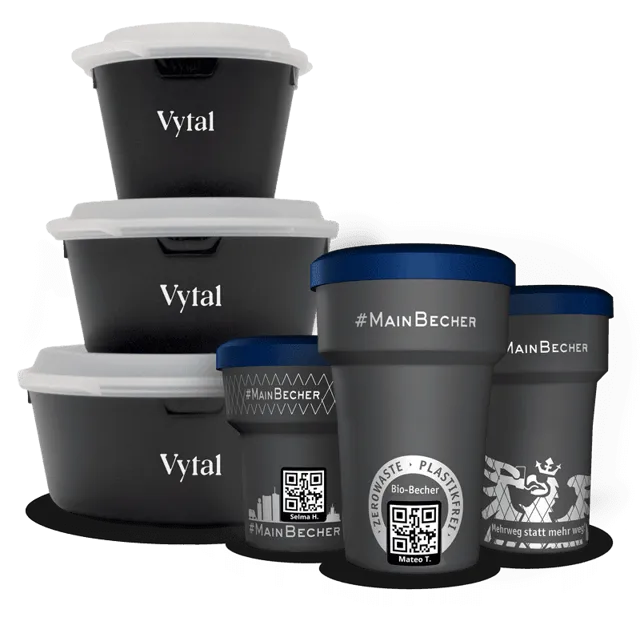
Programme nearbyRepair & ReuseFrankfurtReusable cup & takeaway box network in FrankfurtReusable cup & takeaway box network in Frankfurt Map cafés and kiosks that lend reusable cups and takeaway boxes along the river and main streets, one returnable cup beats a mountain of single-use in Frankfurt. What you can do - Use #MainMehrweg and #MainBecher to find participating venues - Return cups to any partner point, not only where you borrowed - Encourage local businesses to join the pool if they are not listed yet Why it matters Reuse systems only work when enough people return, neighbourhood champions keep the loop spinning.reusecircularlocal
Programme nearbyRepair & ReuseNairobiGjenge Makers plastic waste bricksBuilding materials from shredded plastic waste Gjenge Makers (Nairobi, Kenya) turns plastic waste into affordable building materials, shredding and pressing discarded plastic into bricks and pavers that Impacc reports as seven times stronger and 50% lighter than concrete. What you can do - Source pavers or bricks for community paving, school yards, or yard paths - Organise neighbourhood plastic collection drives that feed local recycling processors - Visit or tour the workshop where possible to learn small-scale production lines How to participate - Enquire about products and collection partnerships via the Gjenge Makers portfolio page Why it matters Plastic litter becomes public infrastructure when makerspaces pair collection with honest engineering, strength tested, weight reduced, cost accessible.plasticrecyclingbricks +2
Programme nearbyCommunityFlorenceTuscany Zero Waste pilot: 51 municipalities mapping the path togetherA regional network learning from each other Since early 2023, Zero Waste Italy has run a pilot programme with 51 Zero Waste municipalities across Tuscany, supporting them to share knowledge, map obstacles, and strengthen the collective path toward Zero Waste certification. The pilot is designed to understand, at scale: what works and what holds municipalities back, so that ZWI can improve its support model for Italy's 340-city network. What the pilot does - Maps current separate collection rates, infrastructure gaps, and political barriers across all 51 municipalities - Facilitates peer learning between municipalities that are ahead and those still building momentum - Produces findings ZWI uses to improve national network support tools How to get involved - If you live in Tuscany, check whether your municipality is part of the pilot and attend any public open days or consultations on waste reduction targets - Contact Zero Waste Italy if your municipality wants to join the regional network Why it matters Supporting 340 municipalities individually is unsustainable. Regional cluster pilots like Tuscany's are how Italy's ZW movement scales its expertise: making every community in the network stronger.networkpilotcircular +2